|
|
|
 |
 |
|
|
|
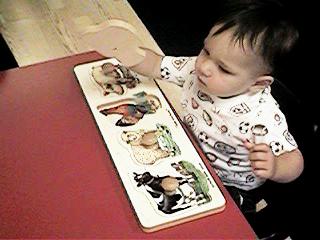
| Working on an animal puzzle |
Infant & Toddler
The Montessori Program provides the sense of security, nurturance
and loving care that infants and toddlers need to thrive during this stage of intense learning. Since infants and toddlers
need to achieve gradual independence, we provide individual attention as your child deals with positive experiences
as well as frustrations.
The curriculum takes advantage of the rapid growth of fine and
gross motor skills including:
-
sensory and perpetual development
-
self-help skills
-
physical and motor skills, and,
-
social and emotional growth
Preschool
Practical Life
Children delight in the abundance of practical life exercises. These exercises
enable confidence in completing activities of everyday life. The desire to imitate adults is satisfied with items especially
scaled to his size.
The child is attracted to the things that give independence and control
in life. They are given experiences of sweeping, dusting, and polishing.
There are exercises for washing, pouring, and gardening. The child is
able to methodically master all of the skills needed for independence.
The delight for the child is in the doing. While he is enthralled
with each exercise, he is developing his concentration, his attention to detail and his coordination of movement. These
exercises are the foundation on which the child approaches all other work.
Sensorial
Wonderful new sensations surround the children continually. The sensorial materials activate
a child's absorption of these new impressions. They enable categorization and organization of the unfamiliar with the
familiar. Each piece of material isolates one definite quality of a sense - color, size, weight, shape, texture, or
sound. Each piece of material stimulates extensive vocabulary building. This sensorial basis is present in many
of the academically-oriented materials.
The importance of the sensorial development cannot be overstated.
When a child develops his senses, he not only develops himself but he forms his learning tools.
|
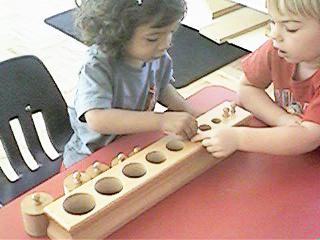
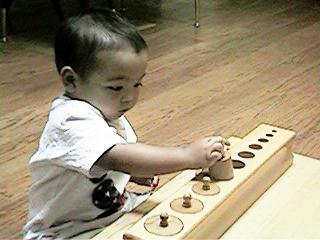
| A toddler working on the knobbed cylinders - a Montessori method of learning |
|
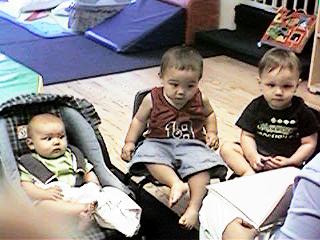
| Listening to a story |
|
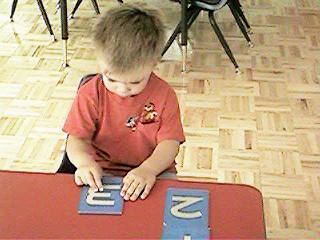
| Tracing sandpaper numerals - a math Montessori material |
|
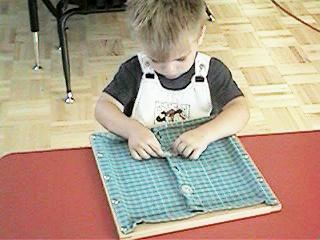
| Mastering the buttoning exercise using the dressing frame - a Montessori material |
|
|
|
|
 |
|
|
|
|
 |
 |
|
|
|
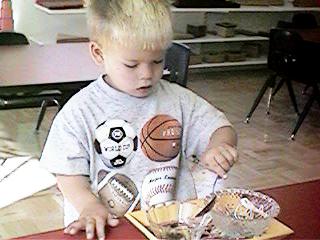
| Developing fine motor skills |
|
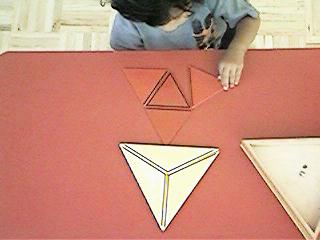
| Constructing a big triangle using small triangles - a sensorial exercise |
|
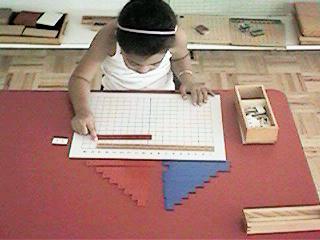
| Mastering subtraction with the help of the subtraction strip board - a math exercise |
Language
Your child has learned the oral language naturally.
He automatically absorbed it from his environment. It is the directress who brings these words to life. Games
fill the children with a love of sounds which becomes personalized. The Montessori child begins rreading when he is ready, and proceeds at his own
pace. There is great glee when the sound "a" is at long last graphically represented. It is basis for reading.
Utilizing your child's desire to touch, the letters are cut out and mounted for tracing. He not only hears the sounds
and sees its shape, but now into tracing, is able to train his muscles for tracing.
Mathematics
The world of numbers and their function is presented to your
child in the most logical, understandable and exciting manner. Each mathematical concept has a concrete piece of apparatus to embody it. By manipulating these exquisitely clear materials,
your child's understanding gains substance. This concrete quality allows him to progress to the realm of fractions and geometry.
Mathematics becomes not terrifying, but a vibrant and inviting new dimension.
Geography
The study of geography includes the use of globes, puzzle maps, flags, picture
folders, books and stories.
Science
The children conduct and observe various experiments with simple equipment.
They learn to identify and classify. The preschool curriculum includes work in zoology, biology, and botany.
Music
Through the use of a special apparatus, the children learn the notes
of the scale and to match and grade them by ear. From this point, they may progress to the composition of simple melodies.
They are introduced to famous composers and to the various classifications of musical instruments
Art
Art is an important part of all life. It is the expression of the spirit
of man. Indirect preparation for art is necessary. Movement exercises are essential to gain body control. Sensorial work
with colors, shapes, and textures help prepare the child. Materials which develop the pincer grasp aid the child in using
pencil, crayon, and brush. Work with shape and dimension helps the child with composition, arrangement and form. Children
decorate their math and writing work.
The environment is decorated with
copies of well-known art works. The child learns to cut, glue, and color and moves on into sewing, knitting, weaving, and
more complicated projects.
|
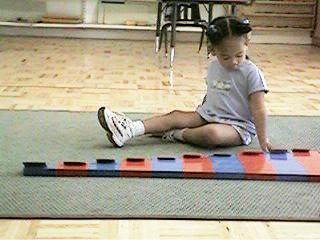
| Associating quantity and symbols of numbers - a math Montessori material |
|
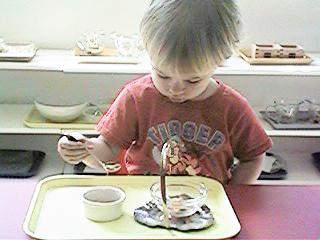
| Transfering Beans - a practical life exercise |
|
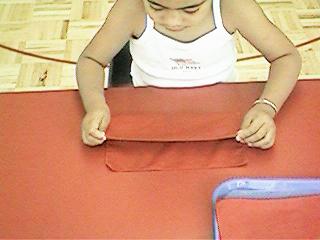
| Folding - a practical life exercise |
|
|
|
|
|